
Prepare for
your Project
Most importantly, measure the area where you wish to pour concrete:
Step-by-Step Calculation
- Convert to feet: If your measurements are in inches, divide them by 12. (e.g., 4 inches is 0.33 feet).
- Find cubic footage: Multiply Length × Width × Thickness.
- Convert to cubic yards: Divide the total cubic footage by 27 (since there are 27 cubic feet in a cubic yard).
- Account for waste: Multiply your final yardage by 1.05 or 1.10 to add a 5% to 10% overage buffer
Ensure that you have your subbase and forms ready to be poured into before pickup!
Before you Pour
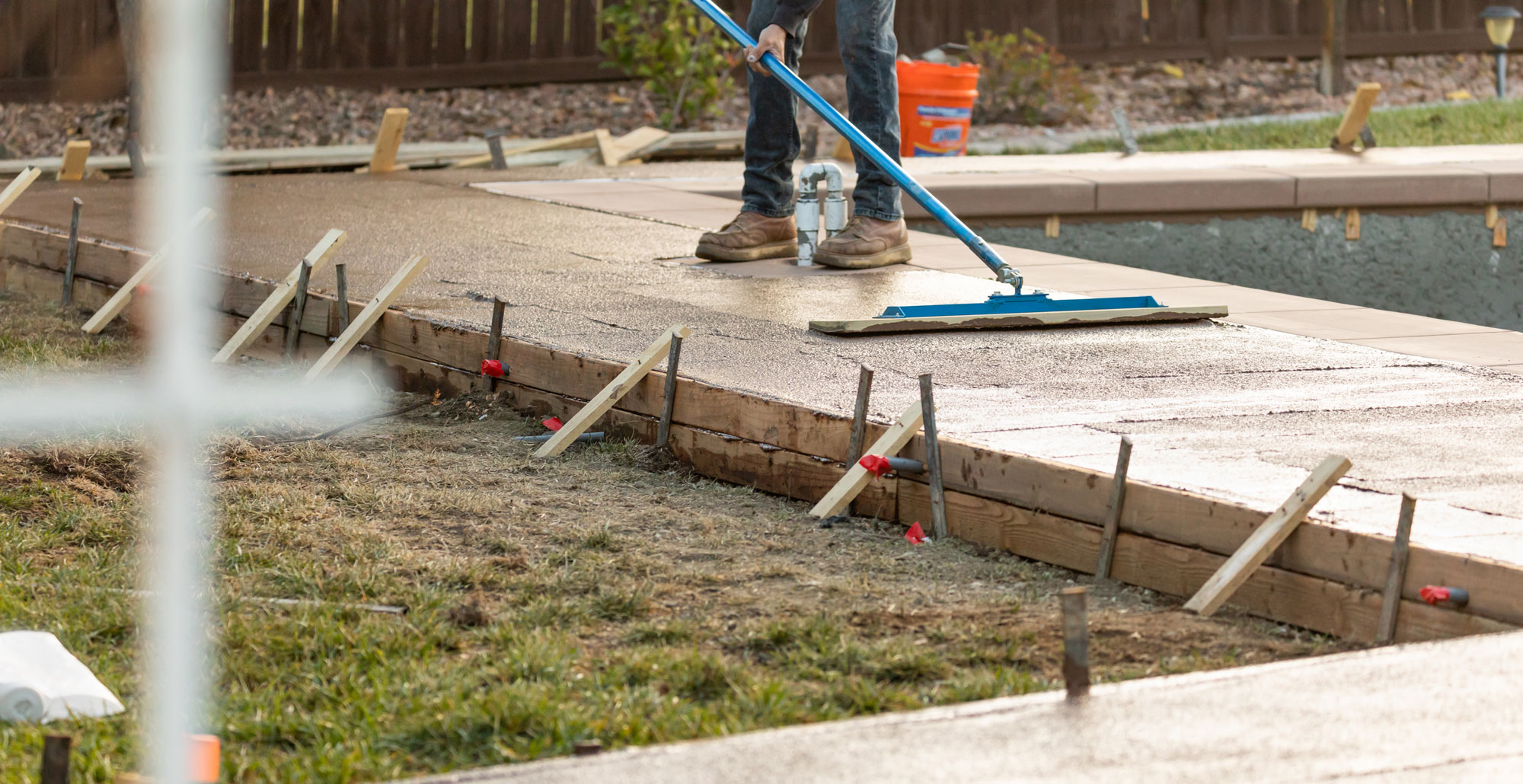
Forms: Most commonly used are 2×4 planks with stakes placed every 18 inches.
- Lay out the corner positions of the slab. Using your stakes and twine, run along the edge to each corner.
- Measure diagonally from corner to corner. Ensure that all measurements are equal.
- Place formboard at corner and alongside your twine. Stake so that 1/8” is above your twine. Be sure to stake deeply enough for the form to have the strength to hold your concrete.
Prepare the Area: Compact the material you have chosen as your subbase (using zero-compaction gravel simplifies this step). You will want about 4-6” of subbase, in some cases more.
Pouring & Finishing
- Wet down the subbase in your formed area with a hose.
- Pour concrete out of the concrete trailer. In some cases, you may need to pour into a wheelbarrow, then dump into the form. Spread the concrete with a square shovel or rake during this step in order to fill the form evenly.
- Use a 2×4 screed board to level. Move back and forth and move from each end. You will need to work quickly to finish before the concrete sets.
- Use a bull float to compact the concrete and allow gravel free concrete to come to the surface. Move away from yourself, then back towards yourself while keeping the tailing end slightly elevated.
- Take a hand float to the surface using sweeping motions after the water bleeds to the surface.
- Use an edger and move it along the edge of your form. This will ensure clean edges when your form is removed.
- Sweep a soft-bristled brush across the surface once it can hold your weight. This will add design and traction to your concrete.
Pouring Concrete Safely
- Wash skin with warm water and soap after contact with concrete. Rinse with vinegar.
- Wear protective safety googles. If wet concrete gets in your eyes, it can cause burns.
- Wear alkali-resistant gloves that resist chemical reactions to alkali materials.
- Wear a long-sleeved shirt and pants. If concrete gets on your skin, it may cause a chemical burn.
- If inhaled, dry concrete can cause damage and irritation to the lungs.
Tools to have on hand

Garden Hose

Wheelbarrow

Trowel

Soft Broom

Stakes & Twine

Rake

Square Shovel

Hand Float

Screed Board

Bull Float

